










HydroChamber™ or Slotted Pump Vault?
A pump vault may look like a less expensive way to build a pondless waterfall reservoir.
But the pump vault is only one component of the reservoir.
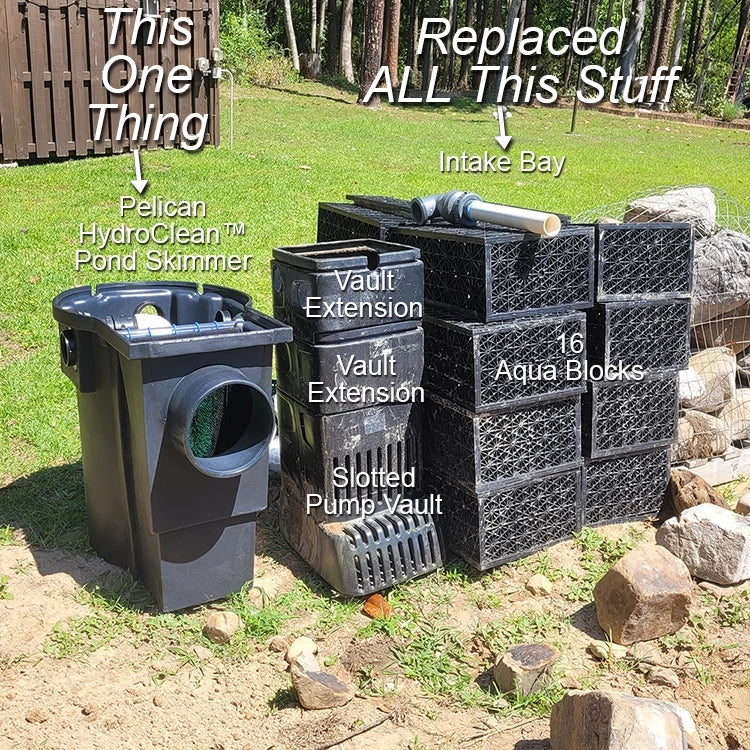
A conventional rock-and-gravel pondless basin typically requires a slotted pump vault, water-storage matrix blocks, underlayment, EPDM liner, rock and gravel — plus the excavation required to contain everything.
The HydroChamber™ takes a different approach.
It combines pump access and approximately 50.9 gallons of usable water storage above the pump (75 gallon total capacity) inside one compact, direct-burial tank.
Compare the Complete Systems
| Conventional Rock-and-Gravel Basin | HydroChamber™ System |
|---|---|
| Slotted pump vault hidden under rocks | HydroChamber™ easy pump access |
| Separate matrix blocks for water storage | Water stored inside HydroChamber™ |
| Underlayment required | No reservoir underlayment required |
| EPDM liner required | No liner required - Direct-burial tank |
| Rock and gravel cover the reservoir | No gravel-filled water-storage reservoir |
| Larger excavation | Compact excavation |
| Pump surrounded by reservoir components | Direct pump access |
| Debris can enter rock-and-gravel reservoir | HydroSieve™ captures larger debris before the HydroChamber™ |
| Reservoir normally located beneath the end of the water feature | Remote installation capable |
| Additional liner, underlayment, matrix blocks, and rock needed needed to increase storage | HydroChambers™ can be connected for additional storage |
Don't compare a HydroChamber™ to the price of a pump vault alone. Compare the complete water-storage systems.
One Tank. Several Jobs.
The HydroChamber™ isn't simply a different style of pump vault.
It is designed to perform several functions within one underground component:
- Pump access
- Water storage
- 4" inlet
- Optional 6" inlet
- Two standard 2" threaded pump outlets
- One optional 3" threaded pump outlet
- ½" threaded connection for optional automatic water fill
- 4" tank-to-tank connection for unlimited water storage
- Multiple-pump capability
- Remote installation capability
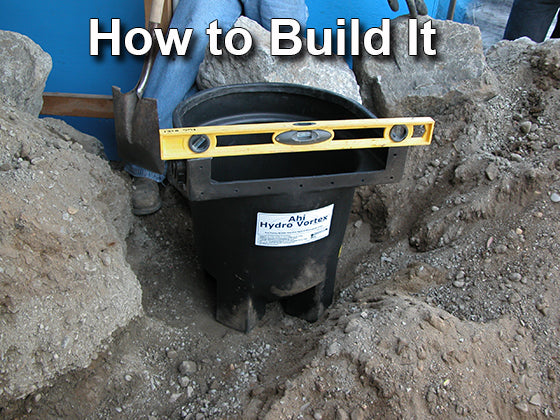
Its heavy-duty rotationally molded HDPE construction allows the HydroChamber™ to be direct buried without building a separate lined reservoir around it.
That can mean fewer components, a smaller excavation and a simpler installation.
Smaller Excavation. Fewer Reservoir Components.
A conventional pondless reservoir stores water throughout a lined excavation containing matrix blocks and a slotted pump vault.
The excavation therefore has to be large enough to accommodate the water-storage structure as well as the pump-access vault.
With the HydroChamber™, the water is stored inside the chamber itself.
There is no need to construct a separate rock-and-gravel water-storage basin around the pump.
Less Excavation • Fewer Components • Easier Pump Access

The Difference Becomes Even Bigger When It's Time to Clean
Installation is only part of the comparison.
A pondless waterfall continuously collects organic material from its surroundings:
Leaves • Blossoms • Seeds • Grass Clippings • Dust • Pollen • Feathers • Insects • Animal Debris
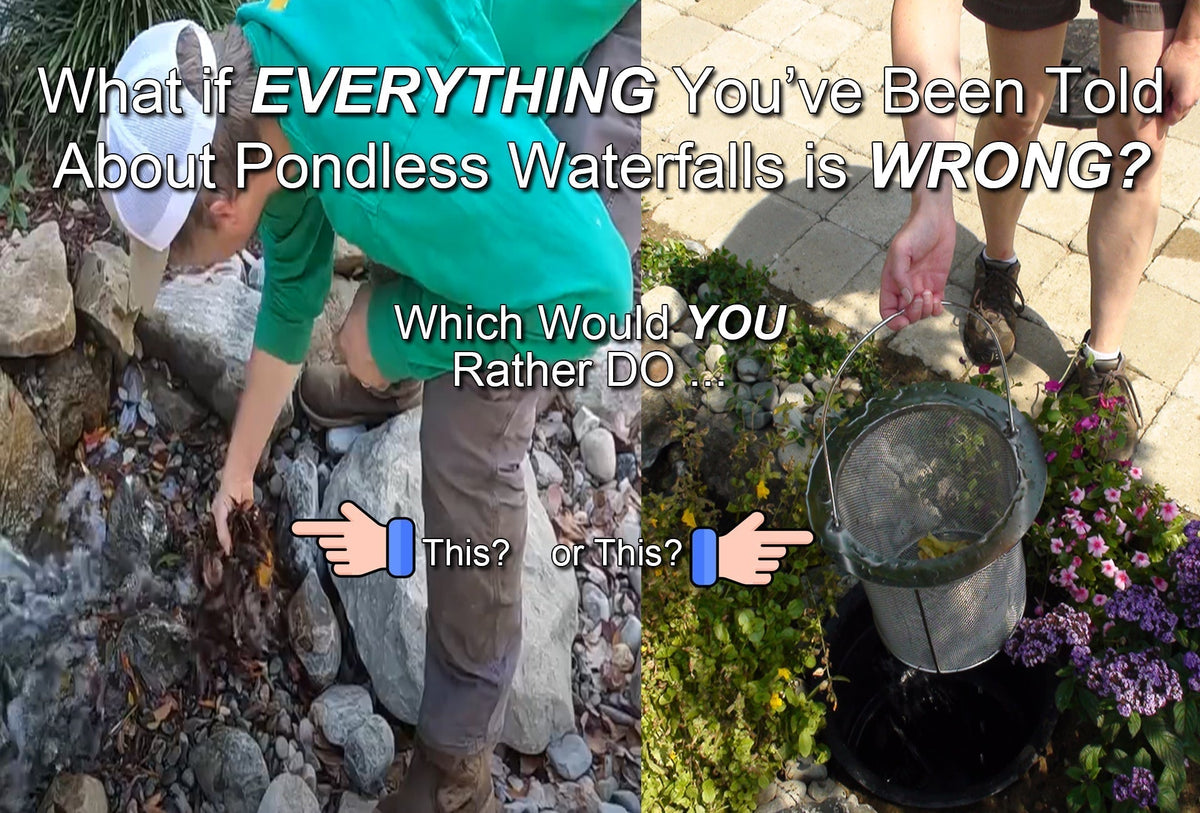
In a rock-and-gravel reservoir, some of that material can work its way between the rocks and deeper into the basin.
Removing accumulated material can require draining the reservoir and physically cleaning the rock and components.
The HydroPure™ approach is different.
Water from the stream enters a HydroSieve™ pre-filter before reaching the HydroChamber™. Larger debris is captured in the removable stainless steel basket where it can be lifted out, emptied and rinsed.
The pump operates in the accessible HydroChamber™ rather than inside a gravel-filled reservoir.
Ask One Question Before Choosing a Pondless Reservoir:
How Do I Clean It?
That question can tell you more about the long-term ownership of a pondless waterfall than simply comparing the initial price of its components.

Pump Access Without Dismantling the Reservoir
The HydroChamber™ lid provides direct access to the pump and stored water.
There are no matrix blocks surrounding the pump and no layer of reservoir rock that must be removed to reach it.
Need to inspect the pump?
Open the lid.
Need to service the pump?
Open the lid.
That simplicity becomes increasingly valuable over the life of the water feature.

Remote Installation Changes What's Possible
A conventional pondless reservoir is generally constructed beneath the lower end of the water feature because that is where the returning water is collected.
The HydroChamber™ doesn't have to be there.
When paired with the HydroSieve™, the components can be installed remotely and connected to the water feature with underground plumbing.
That allows the waterfall and stream to be designed around the landscape and viewing area rather than around the location of a large underground reservoir.
The HydroChamber™ can be positioned where it is:
- Easy to access
- Convenient for electrical service
- Less noticeable in the landscape
- Better suited to the available space
Only the round access lid needs to remain accessible at grade.

Compare Cost of Ownership — Not Just Purchase Price
The least expensive individual component does not necessarily create the least expensive complete system.
When comparing pondless reservoir designs, consider everything required:
Pump vault + matrix blocks + underlayment + liner + rock and gravel + excavation + installation labor + future maintenance
Then compare that with a system built around a direct-burial HydroChamber™ and an accessible HydroSieve™ pre-filter.
The important question isn't simply:
“Which pump vault costs less?”
It's:
“Which complete system do I want to install, maintain and own?”

Replacing an Existing Rock-and-Gravel Pondless Basin
Existing pondless waterfalls with difficult-to-clean reservoirs don't necessarily need to be abandoned.
In many installations, the existing rock-and-gravel reservoir can be removed and the excavation reshaped for a HydroSieve™ and HydroChamber™ system.
We call this a Pondless Basin-Ectomy™.
The old reservoir components are removed, the HydroSieve™ is connected to the water feature, and filtered water travels to the HydroChamber™ where the pump and water storage remain accessible.
The result is a fundamentally different maintenance approach:
Capture debris where you can reach it instead of allowing it to accumulate where you can't.

HydroChamber™ vs. Slotted Pump Vault: The Fundamental Difference
A slotted pump vault and matrix blocks provide water storage and access to a pump located underneath rocks and gravel.
The rock and gravel act like a pre-filter collecting leaves and debris - requiring removal by hand.
The HydroChamber™ provides pump access and water storage inside the same direct-burial tank.
The HydroChamber™ pairs with a HydroSieve™ pre-filter to capture leaves and debris for easy removal.
That is the difference the HydroChamber™ was designed around: