









Why This Brand-New Pond Failed in Just 24 Hours

A newly installed pond should be exciting.
But for one homeowner in Pensacola, Florida, excitement quickly turned into frustration almost immediately.
Just 24 hours after their professionally installed recreational pond — commonly called a “rec-pond” — was completed, the entire pond system began shutting down.
An afternoon Florida breeze blew oak and magnolia tree leaves as well as pine needles into the pond - clogging the Aquascape Intake Bay, and water circulation slowed to a trickle.
Within days:
- the water turned green
- algae growth exploded
- circulation problems worsened
- and maintenance became a constant struggle
The homeowner had invested nearly $70,000 into what was supposed to be a beautiful, low-maintenance backyard pond. Both the certified installation contractor, as well as the certifying equipment manufacturer assured the homeowners that "A pond is easier to maintain than a pool!"
Instead, the homeowners discovered that they were dealing with clogged plumbing, restricted pumps, soggy leaves stuck within the rocks and gravel, and severe algae problems almost immediately after construction. This pond became definitely NOT easier to maintain than a pool.
That’s when Russell Watergardens was called in to investigate and to solve the problem.
What we found revealed a major difference between two completely different approaches to pond filtration design:
- An Intake Bay system is designed to hold leaves within the pond
- A true mechanical pond skimmer is designed for easy removal of leaves from the pond
In this article, we’ll explain:
- how Intake Bays work
- why Intake Bays are prone to fail
- the maintenance problems we discovered
- and how replacing the Intake Bay with a HydroClean™ Pond Skimmer dramatically improved the pond’s performance, filtration, maintainability, and appearance
Key Takeaways
- Intake Bays can struggle in heavy leaf and tree needle environments
- Removing leaves and tree needles from between rocks underwater is very difficult
- Organic debris buildup can restrict water flow and contribute to algae growth
- Mechanical pre-filtration helps protect pumps and plumbing
- Easy-access pond skimmers simplify pond maintenance
- HydroClean™ Pond Skimmers are designed for easier servicing and debris removal
What Happened to This Brand-New Recreational Pond?
Mark and Jessica Morris decided to install a recreational pond in their backyard for themselves and their two boys.
Like many homeowners researching backyard ponds, they started searching online and quickly discovered an overwhelming number of videos featuring beautiful ecosystem ponds built by Aquascape and Certified Aquascape Contractors.
To the Morris family, the sheer amount of content from Aquascape and their contractors created trust in the brand. They ultimately hired an “award-winning” Certified Aquascape Contractor to build their $70,000 dream recreational pond.
Not knowing what questions to ask, the family trusted both the contractor and the filtration system brand being recommended.
The pond featured:
- an Intake Bay instead of a traditional pond skimmer
- and a wetland filter (also known as a bog filter) instead of a traditional mechanical pond biological filter
The contractor assured the homeowners they were getting “the best of the best” — an Intake Bay at one end, a wetland filter at the other, with the pond in between.
When construction was complete, the pond looked beautiful - as new ponds tend to do.
The contractor received final payment and left the job site.
Within 24 hours, the pond system began shutting down.
An ancient oak tree stood near the pond as well as magnolia trees and pine trees. During construction, there had been very little wind. But shortly after the project was completed, a typical Florida breeze carried oak leaves, magnolia leaves, and tree needles (pine straw) directly into the newly installed pond.
The Intake Bay was immediately overwhelmed with leaves and debris.
Leaves, tree needles, and debris worked their way:
- through the river rock
- through the Aqua Blocks
- into the plumbing system
- into the check valves
- and into both external pump filter baskets
Water flow to the waterfalls slowed to a mere trickle.
With reduced circulation and low dissolved oxygen levels, algae growth quickly exploded.
What was supposed to be a low-maintenance recreational pond had already become a serious maintenance problem.
What Is an Intake Bay?

An Intake Bay — sometimes called a skimmer cove — is a rock-lined section within a pond designed to replace a traditional pond-side mechanical pond skimmer.
The system is typically constructed using:
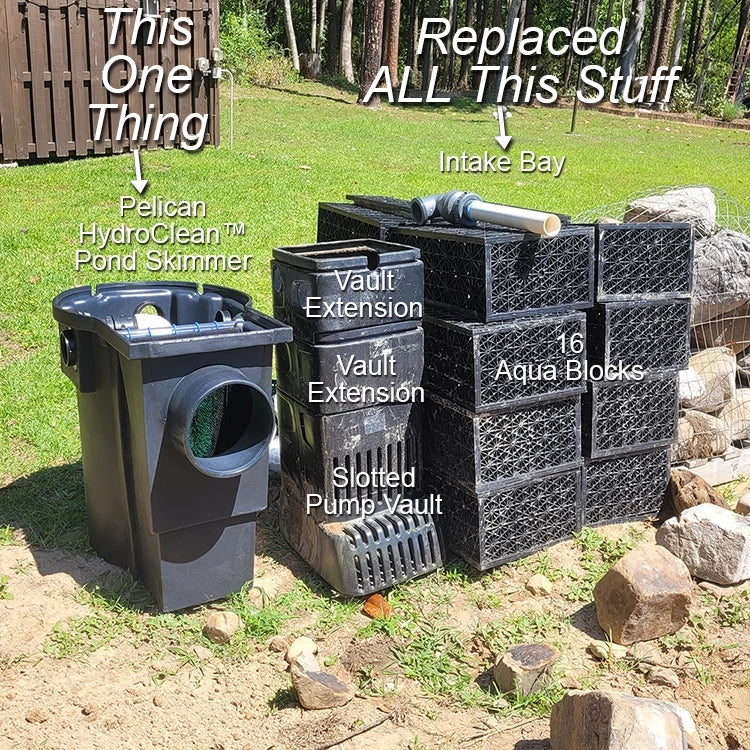
- A slotted pump vault
- Pump vault extensions
- Aqua Blocks
- and river rock placed above the Aqua Blocks to act as a "pre-filter"
Water passes through the river rock, through the Aqua Block chambers, and into the slotted pump vault where the pump draws water out of the system.
How an Intake Bay Works

As water is pumped out of the vault, water from the pond is drawn toward the Intake Bay.
The current pulls floating leaves and debris toward the rock-covered filtration area.
The intended purpose is to pull floating leaves and debris out of the pond and into the Intake Bay area for containment and hand removal.
In theory, the underwater rock and Aqua Block structure acts as the pre-filter system.
However, homeowners should ask a few important questions before choosing an Intake Bay for their pond:
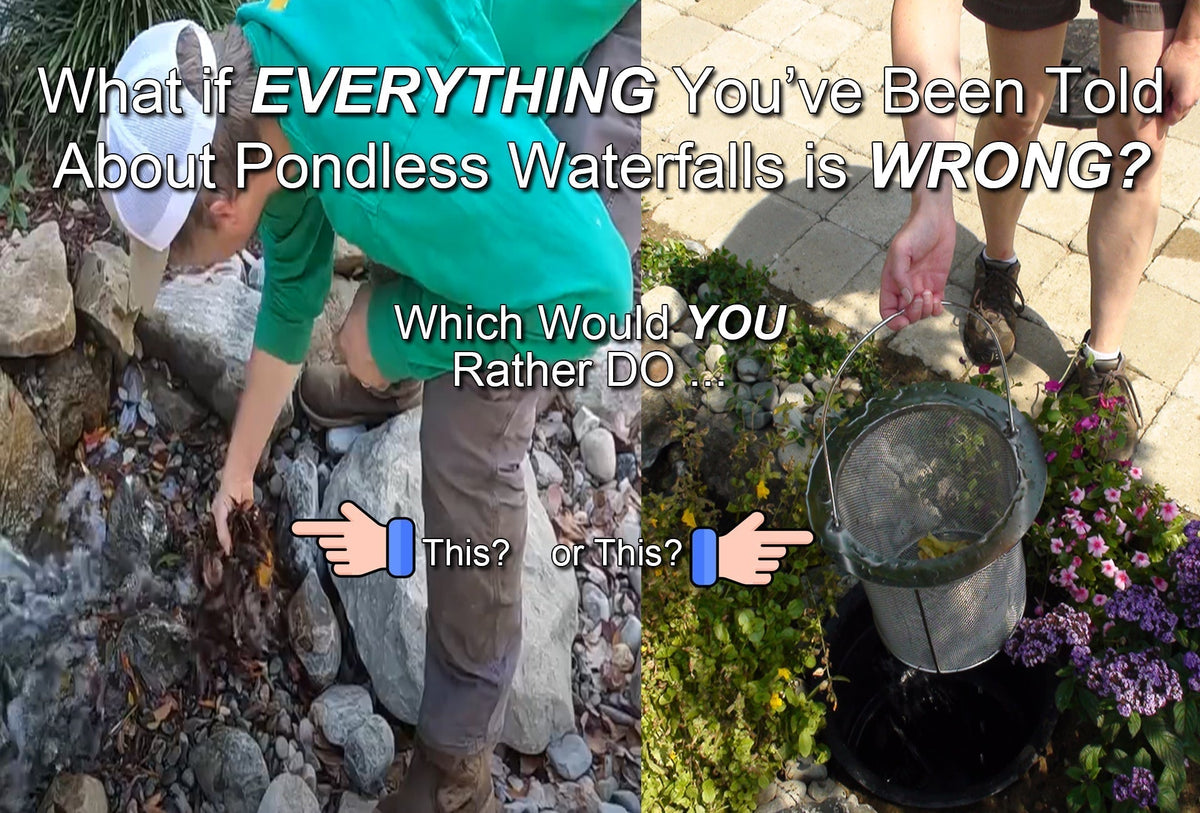
“How do I clean it?”, and "How do I get the leaves off the surface of the water?", and "How do I remove the underwater leaves and debris stuck down inside the rocks, gravel, and Aqua Blocks?"
Those basic questions need to have simple answers.
Because filtration systems should be evaluated based on real-world maintenance conditions — not just how they look on installation day.
The Biggest Problems With Intake Bays
The river rock and Aqua Blocks are intended to prevent leaves and debris from reaching the pump system.
However, in real-world environments with heavy leaf loads, two major problems can occur:
- Leaves and debris can pass through the rock and Aqua Blocks system and eventually clog pumps, plumbing, and check valves.
- Organic debris trapped within the rock and Aqua Blocks begins breaking down into sludge, contributing to poor water quality and algae growth.
In theory, Intake Bays are designed to draw water through gravel and rock before it reaches the pump system.
But in heavy leaf environments like this Florida property, large amounts of organic debris accumulated quickly inside the Intake Bay, restricting water flow and making maintenance extremely difficult.
In this case, leaves passed through the filtration area and clogged:
- both check valves
- both pump baskets
- and portions of the plumbing system
Advantages of an Intake Bay
Some homeowners and contractors prefer Intake Bays for several reasons:
- Natural appearance along the pond edge compared to traditional "pond-side" skimmers
- Large debris holding capacity
- Fish-safe open design without a traditional floating weir door
Drawbacks of an Intake Bay
While the design has aesthetic advantages, several maintenance challenges became apparent on this project:
- Difficult floating and underwater cleaning
- Requires hand-removal of submerged debris
- Limited mechanical pre-filtration
- Not pre-plumbed for multiple pumps
- No integrated overflow port
- No integrated automatic water fill connection
- Higher installation cost compared to many skimmer systems
- Must be installed directly within the pond structure
What Is a HydroClean™ Pond Skimmer?
A HydroClean™ Pond Skimmer by Russell Watergardens is designed to mechanically remove leaves and debris from the pond before they reach the pumps and plumbing system.
The Pelican HydroClean™ pond skimmer uses:
- large stainless steel/nylon leaf net
- Black Knight koi filter brush rack
- True multi-stage mechanical pre-filtration
Leaves and debris are collected in easily accessible above-water components designed for fast servicing and cleanup.
Behind each leaf net are filter brushes that capture smaller debris before it reaches the pumps.
Every model HydroClean™ pond skimmer is also pre-plumbed for:
- two pumps
- an overflow pipe
- and an automatic water fill valve
Unlike many traditional pond skimmers, the HydroClean™ inlet is designed without a traditional floating weir door and can be remotely installed away from the pond edge using standard PVC pipe.
Benefits of the HydroClean™ Pond Skimmer
- Fish-safe design
- Dry-hands servicing
- Large-capacity leaf net
- True multi-stage mechanical filtration
- Filter brush rack for fine debris capture
- Pre-plumbed for two pumps
- Integrated overflow port
- Automatic water fill valve connection
- Can be installed remotely away from the pond edge
- Easier long-term maintenance and servicing
Intake Bay vs. HydroClean Skimmer Comparison
|
Feature |
Intake Bay by Aquascape |
HydroClean™ Pond Skimmer |
|
Leaf / Debris Removal |
Underwater cleanout |
Easy-access leaf net and filter brush rack |
|
Mechanical Filtration |
Limited |
True mechanical pre-filtration |
|
Pump Protection |
Debris can reach pumps |
Multi-stage debris protection |
|
Cleaning Access |
Restricted access |
Fully serviceable above water |
|
Maintenance Time |
High |
Low |
|
Maintenance Labor |
Intensive submerged cleaning |
Easy dry-hands servicing |
|
Overflow Port |
Not included |
Pre-plumbed |
|
Auto Fill Valve Port |
Not included |
Pre-plumbed |
|
Multiple Pump Support |
Limited |
Pre-plumbed for two pumps |
|
Installation Flexibility |
Must be installed within pond |
Can be remotely installed |
|
Installation Time |
Higher |
Lower |
|
Fish Safe Design |
Yes |
Yes |
How the Homeowner Fixed the Pond
The homeowners ultimately decided to completely remove the Intake Bay.
The old Intake Bay area was converted into additional pond space, increasing the pond’s size by approximately 80 square feet.
A Pelican-sized HydroClean™ Pond Skimmer was then installed 32 inches away from the pond using 10-inch PVC extension pipe.
The new setup dramatically improved:
- debris removal
- circulation
- filtration access
- and overall maintainability
- Improved look of the pond
Price Comparison Between the Intake Bay and Pelican HydroClean™ Pond Skimmer
Contractor installed, and the homeowner removed from the Intake Bay:
· 16 Aqua Blocks @ $64.99 ea. = $1,039.84
· One Slotted Pump Vault @ $449.99
· Two Pump Vault Extensions @ $139.99 ea. = $279.98
Intake Bay Total Price $1,769.81
Homeowner installed in place of Intake Bay:
· One Pelican HydroClean™ Pond Skimmer @ $944.99
· 32”x10” Extension Pipe @ $115.20
Pelican HydroClean™ Pond Skimmer with 32" Remote Extension Pipe Total Price $1,060.19
Homeowner could have saved $709.62 by installing a Pelican HydroClean™ Pond Skimmer instead of the Intake Bay and avoided the clogging problems entirely.
Final Thoughts: Easier Pond Maintenance Matters
The goal of any pond filtration system should be simple:
Keep the pond clean, healthy, and easy to maintain.
This Pensacola recreational pond looked beautiful on installation day — but within 24 hours, real-world conditions exposed major maintenance and filtration challenges.
Leaves clogged the Intake Bay, water flow dropped, algae growth exploded, and the homeowner was left dealing with serious maintenance problems almost immediately after construction.
By replacing the Intake Bay with a HydroClean™ Pond Skimmer, the pond gained:
- true mechanical pre-filtration
- faster debris removal
- easier servicing
- improved circulation
- and a dramatically more maintainable design
- a more natural looking pond
For homeowners researching recreational pond filtration systems, three questions that matter more than anything else:
- “How do I clean and maintain it?"
- "How easy will this pond be to maintain five years from now?”
- "What is the annual cost of owning the pond?"
Because long-term pond enjoyment depends on more than how a pond looks on installation day.
It depends on:
- how easily debris can be removed
- how effectively the filtration performs
- how accessible the system is to service
- and how well the pond handles real-world conditions like leaves, algae, and organic waste buildup
Beautiful ponds are important.
But maintainable ponds are what homeowners truly live with long-term.