




Thousands of homeowners search online every year trying to understand why their Aquascape pond keeps turning green or requires expensive cleanings.
Many homeowners are surprised when their beautiful backyard pond suddenly develops algae problems, fish health issues, or requires expensive annual cleanings.

Thousands of pond owners search online every year trying to understand why their Aquascape pond keeps turning green or requires expensive cleanings.
The truth is that many Aquascape-style ponds are designed around a maintenance model that requires annual draining, pressure washing, and sludge removal. In this article we’ll explain why Aquascape ponds often fail, why they require annual cleaning, and how better pond designs eliminate these problems entirely.
So, you're thinking of either building a pond yourself or hiring a contractor to build one for you. Let's address the "elephant in the room" — Aquascape.
You can find multiple CACs (Certified Aquascape Contractors) in virtually every city or town in the country. Aquascape also has a vast dealer network that locally supports all those contractors. There is no shortage of Aquascape contractors or dealers out there.
So the question to ask is: Why?
Aquascape does a great job of motivating their contractors with awards and sales competitions. Being the largest pond filtration supplier in the U.S., Aquascape also has a huge marketing budget to ensure that their website, their contractors, and their products dominate the internet, while smaller companies like ours must rely upon word-of-mouth advertising.
Aquascape filtration equipment, as well as their limited pond designs, are all designed for annual cleaning, and Aquascape trains contractors to create pond cleaning services as an integral part of their revenue. Aquascape and its contractors rely heavily upon annual cleaning revenues as part of their business model.
While annual cleanings — along with loads of gadgets and products for killing algae — add to both the contractor’s and Aquascape’s bottom line, what does that do for the pond owner?

Annual cleanings involve catching and removing all the fish from the pond, completely draining the pond, pressure washing all the rocks and gravel, and pumping out the sludge and slurry. This costs the pond owner thousands of dollars every year they own the pond.
The next question to ask is: Why must Aquascape ponds be drained and pressure washed every year? Other than adding to the contractor’s bottom line, why are these annual cleanings required?
Why Aquascape Ponds Require Annual Cleaning

Aquascape BioFalls filters are not designed for routine cleaning. In fact, the only way to clean them is to physically climb up to the top of your waterfall and manually remove the soiled media nets filled with either bio-balls or lava rock. Then you must reach further down into the filter to remove the soiled filter pads. The media nets and filter pads must then be rinsed clean so that water can flow freely through them. This takes quite a bit of time, water, and strength to lift the heavy, soiled media.

One thing to note: if you clean the filter media with high-pressure chlorinated water from a garden hose, you will rinse off the beneficial bacteria along with the sludge and muck. This causes the biofiltration system to start over every single year. This is why Aquascape ponds often experience algae blooms after annual cleanings.
Another thing to consider is that a filter of any kind — whether it’s a pond filter, air filter, oil filter, or coffee filter — performs at its peak when kept free of debris. A clogged filter no longer filters effectively because the water, air, oil, or coffee will simply travel around the clogged filter. A pond filter is no different.
What Happens Inside a Clogged Pond Filter

A pond filter traps organics from the water. Bacteria living on the filter media inside the pond filter consume nutrients and ammonia from the water. As the filter does its job of trapping organics, it can only trap so much before it can’t trap any more. At the same time, healthy oxygen-breathing bacteria consume organics and ammonia from the water. But like any living thing that eats, bacteria produce waste too. The bacteria create their own waste product called detritus within the filter media inside the filter.
If the filter media isn’t periodically rinsed free of trapped organics and detritus, it clogs up and can no longer continue trapping organics any further. The clogged filter media then forces the flowing water to simply travel around the filter media — bypassing the filter media altogether. This is known as channeling within the filter.
When oxygenated water channels around the filter media, the oxygen-breathing bacteria start to suffocate from lack of oxygen and begin to die off, leaving dissolved organics and ammonia in the water. Also, areas within a clogged biofilter that no longer receive oxygenated water become anaerobic (oxygen-deprived). This creates a breeding ground for anaerobic bacteria to take over the filter.
Anaerobic bacteria can cause all kinds of fish sickness and death, from mouth and fin rot to open ulcers.
Since cleaning an Aquascape BioFalls filter requires manual removal and rinsing of the bio media from inside it, Aquascape recommends cleaning the filter annually instead of routinely.
Not routinely rinsing organics and detritus from the biofilter causes the filter to become less efficient the more clogged it becomes. A clogged filter can no longer filter effectively, so the organic-rich water simply passes around — or channels around — the filter media and back to the pond, where it settles to the bottom.
The Problem With Rock and Gravel Pond Bottoms

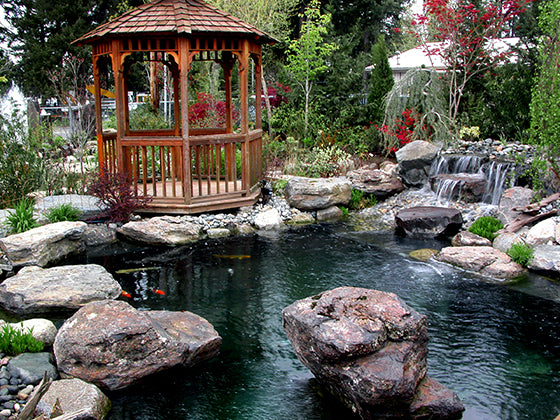
Another problem with Aquascape pond designs is the rock and gravel on the bottom of the pond. Swimming pools, koi ponds, and hybrid ponds all have smooth bottoms sloped to a bottom drain for the removal of sunken organic debris.
Aquascape pond designs typically feature rock and gravel on the pond bottom with no bottom drain. This means all the organics that cannot be removed from the water by the filtration system simply settle to the bottom of the pond. This organic matter then rots and decays in the gravel.

The decaying organic matter becomes on the pond bottom becomes anaerobic just like the clogged filter. The huge problem with decaying organic matter within the rock and gravel at the bottom of the pond is that it becomes a breeding ground for pathogenic bacteria such as Aeromonas and Pseudomonas, which cause fish disease and death.
Why Aquascape Ponds Develop Algae Problems
A clogged biofilter and a pond bottom filled with rock and gravel can become toxic to your fish while at the same time becoming an unlimited buffet for algae growth. Algae grows when nutrients are available to feed it.
Not routinely rinsing the BioFalls filter causes it to become less efficient every day it is not cleaned. Dirty rock and gravel at the bottom of the pond cause algae growth and fish health issues.
The reason Aquascape ponds fail is because they are not designed for routine maintenance. They are designed as settlement tanks, where organic debris remains in the filter and at the bottom of the pond until the next “annual” cleaning.
A Better Pond Design: Russell Systems
Russell Pond Systems, on the other hand, are designed for simple, quick, routine backwashing of the filtration system.
Also, if gravel is to be installed at the bottom of the pond for aesthetic appearance, we recommend a thin layer of pea gravel only — no drain rock and no river rock.
A smooth, bare liner sloped toward a bottom drain connected to a HydroSieve™ bottom-drain prefilter is the best option for the pond bottom. But if you don’t like the look of bare liner, a thin layer of pea gravel can be used.
The reason for pea gravel is that sunken debris will remain on top of the pea gravel for easy removal with a net instead of becoming trapped inside larger river rock.
Pea gravel at the bottom of the pond can be kept clean simply by using a garden hose with a nozzle to “fluff” the gravel into the water column, where it will then be sucked into the filtration system and removed with a simple backwash — no draining of the pond required.
FAQ: Aquascape Pond Problems
Do Aquascape ponds need annual cleaning?
Many Aquascape pond contractors recommend annual draining and pressure washing to remove sludge trapped in the rock and gravel bottom.
Why do Aquascape ponds get algae?
Excess nutrients from decomposing debris and clogged filters create ideal conditions for algae growth. Algae grows when it has nutrients that feed it.
Is gravel bad for pond bottoms?
Rock and gravel can trap organic debris that decomposes and produces harmful bacteria if it is not routinely removed. A thin layer of pea-gravel is preferred over rock and gravel for ease of removing debris that settles onto it.
What is the best pond bottom design?
Koi ponds, Hybrid Ponds, and CrossOver Ponds use smooth liners sloped toward bottom drains so debris can be removed continuously.